Creating a segment
Segments turn subscription, lifecycle, CRM/CDP and application data into customer contexts you can act on and measure. Use them to target different flows, questions and interventions, then compare how each group responds.
A segment can include criteria such as MRR, billing interval, subscription duration, plan, CRM or CDP data and custom properties from your application or service.
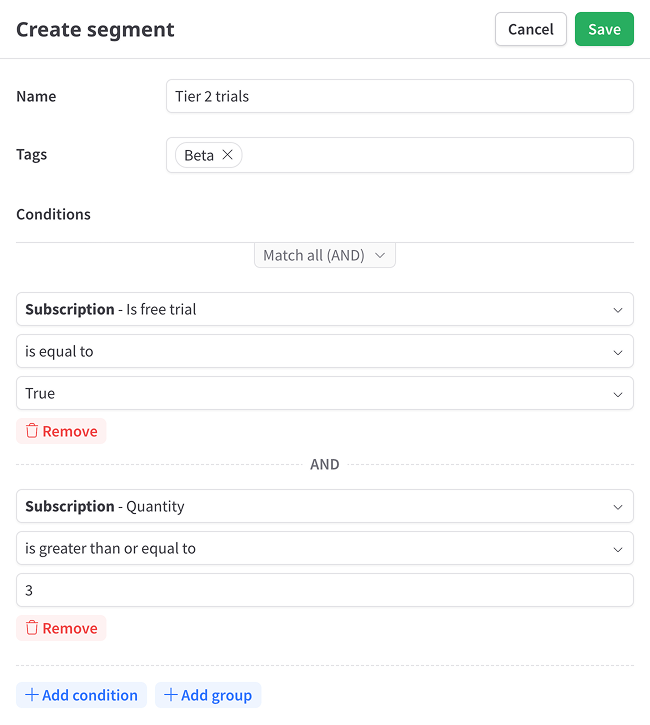
To create a segment, click Segments in the left navigation and then the Create segment button. Segments can also be created when adding or editing offer rules.
Basic details
Enter a name for your new segment.
Tags
Use tags to categorize your segments. Find relevant segments faster with the tag dropdown on the Segments page. To create a new tag, type the name and click + Add.
Conditions
Segments are made up of conditions that define which customers belong to the
segment. Each condition contains a property, an operator and a value. For
example, Subscriber – MRR is greater than $100.
Choose All above the conditions to require every top level condition and condition group to match. Choose Any to require at least one to match.
Click Add condition to add another condition at the current level. Click Add group to create a condition group, then choose All or Any inside that group to control how its conditions are combined. A group can contain conditions but cannot contain another group.
When the segment is complete, click Save.
Operators and values
The available operators depend on the selected property's type.
| Property type | Available operators | Value |
|---|---|---|
| Text | is equal to, is not equal to, contains, does not contain, starts with, ends with, is set, is not set | Enter text. is set and is not set do not require a value. |
| Number, currency or percentage | is equal to, is not equal to, is greater than, is less than, is greater than or equal to, is less than or equal to | Enter a number or monetary amount. |
| Date | The numeric comparison operators above, plus is within the last # days, is more than # days ago, is within the next # days, is more than # days from now, is on day of week, is not on day of week, is set and is not set | Choose a date for a direct comparison, enter a number of days for a relative comparison, or choose Sunday through Saturday for a day-of-week comparison. |
| True or false | is equal to | Choose True or False. |
| Listed choice | is equal to, is not equal to, is set, is not set | Choose one of the values supplied by the property. |
| Location | is equal to, is not equal to, is one of, is not one of | Choose one country and state for an equality comparison, or multiple locations for is one of and is not one of. |
| ID | is equal to, is not equal to, contains, does not contain, starts with, ends with, is one of, is not one of | Enter or select one value for an equality comparison. Select multiple values for is one of and is not one of. |
For plan, add-on, product, offer, coupon and cancellation reason properties, ProsperStack provides a searchable selector of eligible records. Equality operators accept one selection; is one of and is not one of accept multiple selections.
Available properties
These are the default properties available when a subscription platform is connected. Check out custom properties for more targeting options.
Subscriber
- MRR — The subscriber's total monthly recurring revenue
- LTV — The subscriber's total lifetime value
- Status — The subscriber's status (Active, Canceled, Saved or Reactivated)
- Active offer ID — The ID of the offer last accepted by the subscriber
- Active coupon ID — The subscription platform ID of the coupon applied to the subscriber
- Days since saved — The number of days since the subscriber was saved
- Last session date — The date of the subscriber's most recent flow session that reached a terminal state (canceled, saved, deflected, or incomplete)
- Last session start date — The date the subscriber most recently started a flow session, including sessions they did not complete. This property reflects in-progress sessions from prior visits, making it useful for suppressing a step for subscribers who recently entered the flow even if they did not finish it.
Subscription
- MRR — The subscription's monthly recurring revenue
- LTV — The lifetime value of the subscription
- Is free trial — Whether or not the subscription is on a free trial
- Status — The subscription's status (Trialing, Active or Canceled)
- Duration (days) — The number of days since the subscription was created
- Will renew — Whether or not the subscription will automatically renew at the end of the current billing period
- Next billing date — The subscription's next billing date
- Is past due — Whether or not the subscription is currently past due
- Active coupon ID — The subscription platform ID of the coupon applied to the subscription
- Discount percentage — The discount percentage of the subscription's active coupon
- Discount fixed amount — The fixed monetary discount amount of the subscription's active coupon
- Last session date — The date of the most recent flow session for this subscription that reached a terminal state (canceled, saved, deflected, or incomplete)
- Last session start date — The date the subscriber most recently started a flow session for this subscription, including sessions they did not complete.
Session
Session properties describe the most recent cancellation session for the subscription being evaluated.
- Created date — The date the session was created
Product
- ID — The subscription platform product ID
- Name — The name of the subscription's product
Plan
- ID — The subscription platform plan ID
- Interval — The billing interval for the plan (Day, Week, Month or Year)
- Interval count — The number of units per billing interval, for example "2" for a plan that bills every two weeks
- Quantity — The subscription's plan quantity
- Name — The name of the subscription's plan
Add-on
- ID — The subscription platform add-on ID
- Name — The name of the add-on
Custom properties
Aside from the default available properties, segments can also use any of your custom properties. Learn how to create custom properties in the next section.
Editing a segment
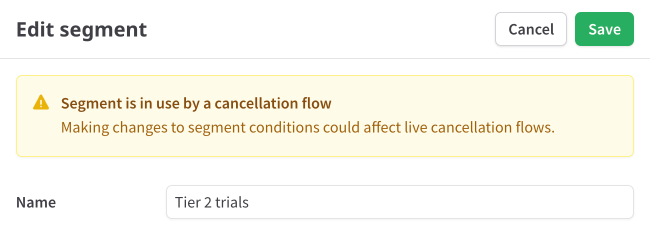
To edit a segment, click the pencil icon at the top of the segment page.
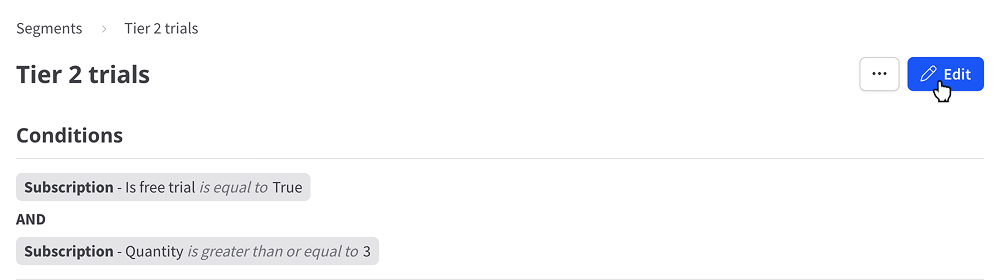
Editing a segment's conditions may affect your live cancellation flow, so make sure to test your changes in test mode before updating segments that are part of your flow routing rules, offer rules or step conditions. ProsperStack will warn you when editing a segment that's currently in use by a cancellation flow.